


A Classroom That Thinks About Thinking: Why Metacognitive, Self-Directed Learning Matters

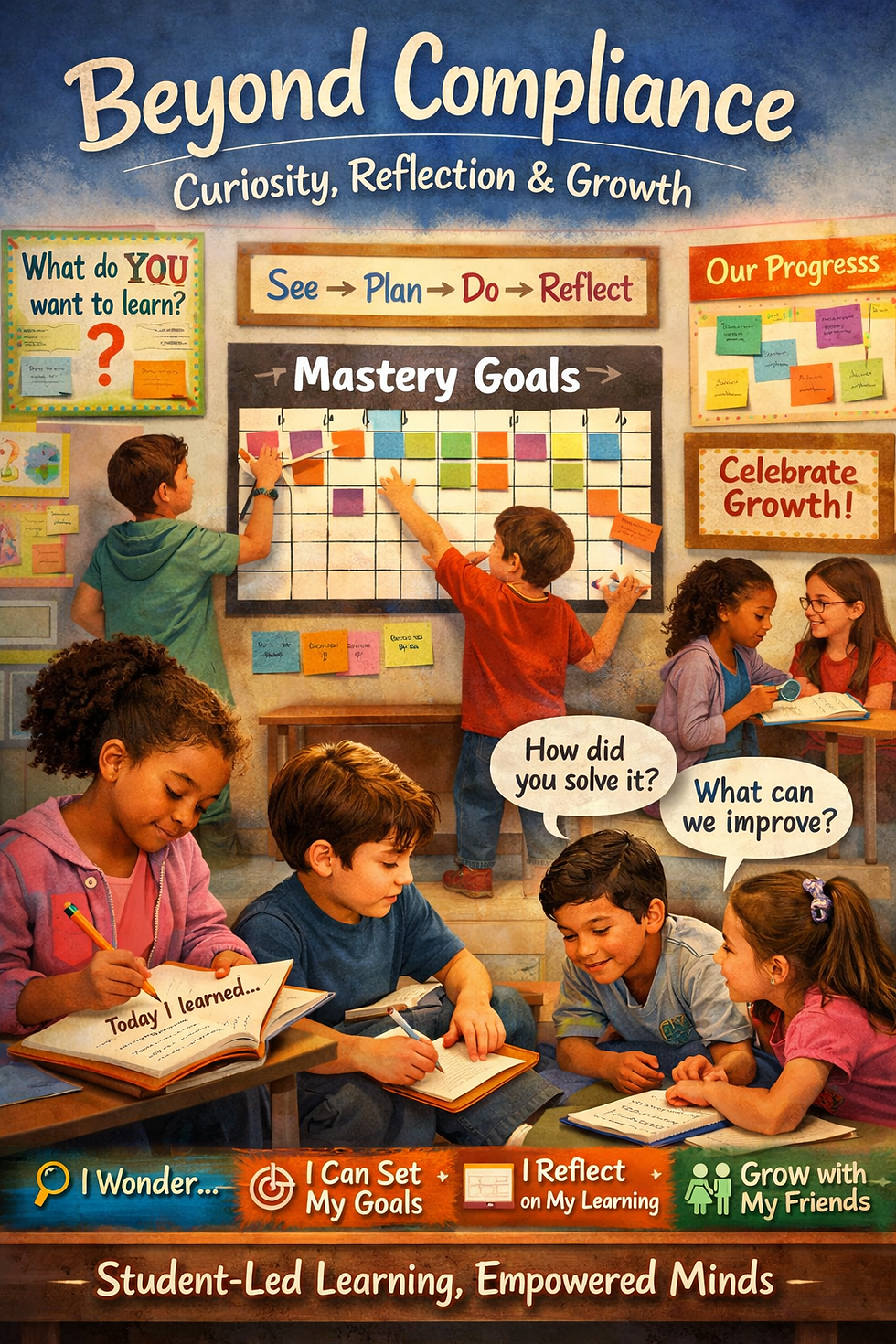
Walk into a classroom built around concepts supported by self-determination and self-directed learning, and you might notice something unusual. Instead of students all completing the same worksheet or reading the same passage to learn the same concept or skill under the watchful eye of a single teacher, you see children choosing to learn something that day because they know it will help them prepare to do something bigger they want to master; you see students posting reflections, updating mastery charts, talking with peers about whether how they solved a problem works or could be improved upon, and celebrating discoveries and growth.
There’s structure here, but it’s not the kind that confines. It’s the kind of structure that frees.
🧠 Beyond Compliance: Honoring Natural Curiosity and Metacognitive Growth
Children in the elementary grades are, by nature, self-motivated learners. They arrive at school filled with questions about how the world works and generally eager to explore, test, and discover the boundaries of their world. This drive to understand is innate and is not manufactured. Long before worksheets or reading programs are introduced, children are learning through observation, play, experimentation, and storytelling.
When classrooms replace this natural drive with manufactured systems i.e. packaged programs, scripted lessons, and one-size-fits-all comprehension tasks, we unintentionally train students to seek external validation from those programs rather than from internal understanding. They learn to complete tasks, not to cultivate curiosity.
The goal of a metacognitive classroom is to restore that natural learning instinct. This gives students back the structure of reflection rather than the structure of compliance.
True learning happens when students begin to see themselves as thinkers who can plan, monitor, and reflect on their growth. Metacognition isn’t a luxury skill for older students. It’s the bridge between a child’s natural wonder and their developing ability to direct that wonder intentionally.
When children can pause to ask:
"Why am I in school?"
“What am I trying to learn?”
“What strategy will help me reach my goals?”
“How well did those strategies work, and what will I do to improve next time?”
This shifts the focus of the classroom from effective teaching to meaningful learning, transforming education from a series of teacher-led assignments into a lifelong practice of student-led curiosity, reflection, and growth.
🎯 The Developmental Foundation: Thinking Grows in Stages
This approach isn’t abstract theory. It’s grounded in developmental science.
Piaget’s Concrete Operational Stage reminds us that children ages 7–11 learn best when they can see, touch, and track their thinking. That’s why visual tools like data walls, anchor charts, and reflection posters make learning tangible.
Erikson’s Industry vs. Inferiority stage highlights a child’s growing need to feel capable and productive. When students see their progress posted on mastery walls or reflected in “What I worked on today” notes, they internalize a sense of pride — not from grades, but from growth.
Kohlberg’s Conventional Morality shows that moral development at this age revolves around fairness and contribution. Tools like “Peer Coaching Prompts” and “Conflict Resolution Charts” teach students not only how to learn, but how to be with others in a shared community space of (and for) learners.
🌈 Making Learning Visible
Every anchor chart and poster in this classroom serves one purpose: to make learning visible.
The Metacognitive Cycle (See → Plan → Do → Reflect) helps students frame their process.
The Joy Cycle (Learn → Help → Have Fun → Repeat) reminds them that motivation thrives on connection and play.
The How to Find Help Map teaches resourcefulness before dependency.
The Daily Reflection Parking Lot bridges today’s effort with tomorrow’s goals.
These are just a few of the kinds of tools that are not decorations--they are cognitive mirrors. They externalize the invisible and turn reflection, perseverance, and empathy into things students can see, name, and practice.
🤝 From Independence to Interdependence
A common misconception is that a "self-directed" learner learns in isolation.
The self-directed classroom celebrates learning as a social activity. It’s about building autonomous interdependence where every learner has agency and every learner supports others’ agency and growth.
That’s why the classroom purpose statement reads:
“We are here to learn, help others learn, and have fun in the process.”
This shared purpose anchors the culture in community rather than competition. Students track their own mastery as well as their peers’. They learn to ask for help, offer support, and reflect on their experiences together. Over time, they don’t just develop skills, they develop interdependent systems of empathy, collaboration, and confidence.
🪞 The Morality of Metacognition
At its heart, this classroom model isn’t just about better academic outcomes (though it produces those). It’s about nurturing moral and emotional maturity.
When students reflect daily, take responsibility for their goals, and understand that learning is both personal and communal, they develop the habits of self-awareness, empathy, and integrity that carry far beyond school walls.
They learn through daily and weekly experiences and discussions that every day offers new chances to:
Notice what they’re learning
Reflect on how they’re growing
Celebrate progress
Plan what comes next
And that’s not just good teaching — that’s moral education in motion.
Because in practicing metacognition, students are also practicing moral cognition: learning to think about their choices, consider others’ perspectives, and align their actions with shared values. They come to see that how they learn is as important as what they learn.
🎮 “But Won’t They Just Choose Fun?” — Understanding Dopamine, Choice, and Learning
One of the most common concerns raised about self-directed learning is this: If students are given choice, won’t they just chase dopamine via silly games, social distractions, and surface-level fun, instead of engaging in meaningful academic learning?
It’s a fair question. And it’s rooted in a real observation about human behavior.
But it rests on an incomplete understanding of both dopamine and childhood development.
Dopamine is not the chemical of pleasure; it is the chemical of anticipation, progress, and motivation. It is released not only when something is fun, but when something feels worth pursuing, when effort leads to visible improvement, and when competence grows through challenge. In other words, dopamine fuels engagement, not avoidance of effort.
In traditional classrooms, students often seek “dopamine hits” through distraction because meaningful motivation around academic learning has been stripped away — academic achievement is happening to them rather than because of their choices. When learning is reduced to compliance (e.g. finish this worksheet and receive approval via grades) students naturally look elsewhere for stimulation and agency. This is where silly behavior becomes a common substitute for ownership.
In a well-designed self-directed classroom, the opposite occurs.
Because expectations, reflection systems, and shared purpose are explicit, students quickly learn that choice is not the absence of responsibility. They are free to choose how they work toward goals, not whether growth matters. Fun is not eliminated—but it is contextualized.
Students learn, often very quickly, that:
Games without growth feel empty
Avoidance creates stagnation
Progress feels better than distraction
Mastery is more rewarding than novelty
This is where metacognition becomes the regulating force.
Daily reflection tools, mastery tracking, peer feedback, and goal-setting cycles gently but consistently ask students to confront questions like:
Did what I chose today move me closer to my goals?
What felt satisfying—and why?
What felt fun but unfulfilling?
What challenge gave me the strongest sense of accomplishment?
Through this process, students don’t need adults to constantly redirect them away from “dopamine chasing” but rather to help differentiate between shallow stimulation and deep satisfaction on their own.
Importantly, this learning is developmental. Younger students may initially lean toward playful choices, and that’s not a failure of the model. It’s data. With consistent reflection and visible growth systems, play evolves into purpose. Fun becomes integrated with learning rather than competing with it.
However, middle school students entering a self-directed environment for the first time may initially respond to newfound autonomy by disengaging altogether. We might see them gravitate toward games, socializing, or apparent “nothingness,” not because they lack curiosity, but because years of compliance-based schooling have taught them that learning is something done to them, not by them.
Recalibration during adolescence involves inaction as a form of structural testing: Will anyone stop me? Does this actually matter? Am I really responsible now? With consistent structures e.g. clear expectations, visible competency targets, required reflection, and community accountability, this phase rarely persists beyond a single academic year. As students experience the natural consequences of stagnation and the satisfaction of progress, they begin to reengage. Academic work stops feeling like an imposed task and starts functioning as a tool for reclaiming agency, identity, and credibility. What looks like avoidance at first is often the unlearning of passivity, and with time and support, autonomy gives way to purpose.
Over time, students internalize a powerful insight:
The most rewarding experiences are the ones where effort turns into understanding.
That insight cannot be taught through control. It must be experienced.
A self-directed classroom doesn’t assume students already have perfect self-regulation. It builds it, one reflective choice at a time. And in doing so, it prepares students not just to manage dopamine—but to manage themselves.
✨ Closing Reflection
A classroom built on metacognition doesn’t eliminate structure — it redefines it. Instead of rules that constrain, students have systems that empower. Instead of chasing grades, they celebrate growth. Instead of being told what to learn, they learn to tell themselves, “Here’s what I want to understand next.”
Because when a classroom thinks about thinking, it stops being a place of work and becomes a place of wonder.
Greg Mullen
December 22, 2025


